

MRRN
AERODROME
| Origin | Time | Status |
|---|---|---|
| Zürich | 09:40 | Approaching |
| Paris | 12:15 | Expected |
| London | 14:20 | Headwind |
| New York | 08:15 | Tomorrow |

by the Sportchalet Mürren
At the edge of the village lies a port. Behind it, the Sportchalet; in front, the Lauterbrunnen valley. Airships moor here. A mast, a windsock, a small reception hut. Most of the facility consists of a view.
A question
of terrain.
The story of MRRN Aérodrome begins with the search for a suitable piece of ground. In the late 1920s, there is a wish to connect Mürren to air travel. The village has long welcomed guests from far away. Getting here, however, involves several stages, different means of transport and, occasionally, a certain amount of determination.
A direct connection seems desirable. A runway proves difficult.
The search eventually leads to the Mürrenfluh, the valley-facing edge below what is now the Sportchalet. Here the terrace ends. Beyond it, space continues generously.
A useful starting point for an airship.
In 1929, the first experimental station is built: an anchored mast, a firm approach path and a wooden shelter for people, ropes and things best kept dry. Early documents call it Mürren Airship Station. Permission is initially granted on a provisional basis.
The provisional arrangement proves its worth.
International
connections.
One counter.
The Zurich–Mürren service begins in 1931. London follows in 1934, then Paris–Mürren–St. Moritz in 1936. The experimental station becomes an airship port. Its printed stationery now reads MRRN AERODROME.
For the time being, international traffic can be handled at a single counter. Arrivals and departures use the same desk, at different times.
Along with travellers come letters, suitcases and selected goods for the village houses. The ground crew know a considerable number of the recipients personally. Experience helps when an address is incomplete.
Over the years, facilities are added, fittings replaced and new connections entered in the timetable. The layout remains manageable. For expansion, there is mainly the sky.

The mooring
at the cliff.
The airship approaches over the valley. From the village, the pale hull appears first, then the gondola, and finally the people behind its windows. Mooring takes place at the edge.
The tennis courts lie between the Sportchalet and the cliff edge. The approach to the mooring leads past them.
The mooring connects two very different understandings of keeping one's feet on the ground. Passengers step outside and, a few paces later, stand on a Mürren footpath. Their luggage follows on a trolley.
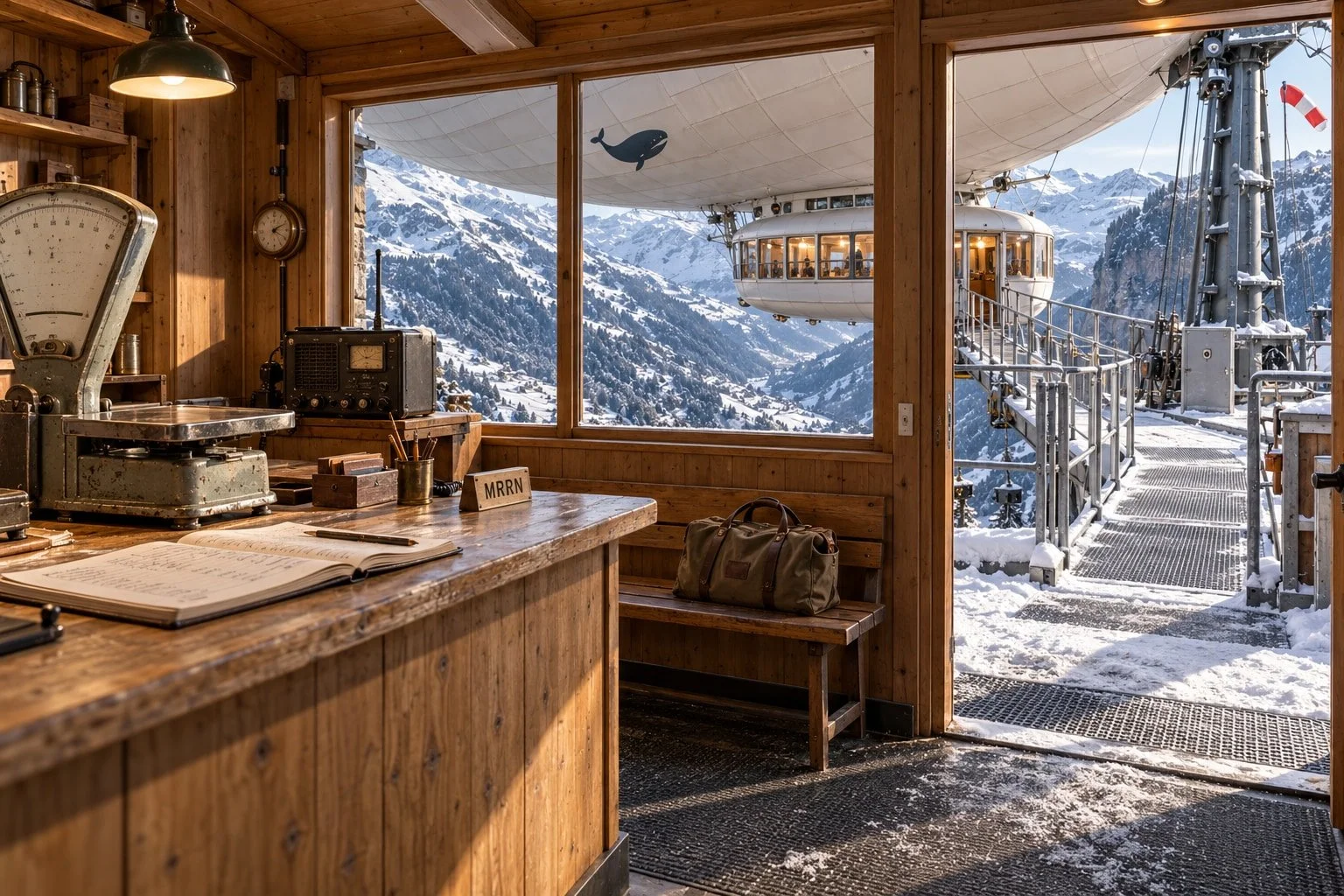
The mast bears traces of successive decades of operation: riveted steel, renewed connections, more recent technical additions. The small reception hut contains a counter, a bench, a luggage scale and a window onto the valley. A windsock and an anemometer stand alongside. The weather log is kept by hand.
On some days, it contains more entries than the arrivals book.
The address
on land.
Over the years, the Sportchalet becomes part of the daily operation. At first, the crew find a warm meal there. Later, rooms are provided for travellers whose onward journeys have been delayed. Waiting guests settle inside. Someone asks about the weather. Someone else looks out.
And so the Sportchalet becomes the Aérodrome's address on land.
Below, they attend to mooring; above, to arriving. A short walk and an established working relationship connect the two. For longer stays, the journey acquires a room key.
The connection is visible indoors, too. Pictures, travel posters and occasional traces of airship operations form part of the MRRN visual world in the house. You encounter them on your way through the Sportchalet. Some destinations begin on the staircase.
Two ships.
Much travelling.
Today, the Aérodrome is the home port of MRRN Air Ways.
THE WHALE
THE WHALE · HB-MRR carries the whale on its pale hull. The red tail fin with its white Swiss cross remains visible even as the ship grows smaller over the valley.
Discover THE WHALE →COSMOPOLIT
Its sister ship, COSMOPOLIT · HB-MRC, carries the flags of many countries. At the Mürren mooring, its hull resembles a world map that has briefly tied up.
Both belong to an airline with a generous understanding of travel time. Zurich is close; Paris a little further away. London occasionally meets a headwind. New York calls for several stages and a suitably open calendar.
Higher. Slower. Further.
Operations
today.
A flight day begins with weather observations and radio contact. The ground crew prepare the mooring, bring out the luggage trolley and take delivery of provisions. Travellers gather only when arrival is in sight.
On the board, origin, time and status change.
APPROACHING. MOORED. WEATHER PERMITTING.
The information is updated. The sky keeps moving.
The via ferrata begins close by; a BASE-jumping exit point lies beside the Sportchalet. The edge is part of present-day village life. People prepare, check their equipment and wait for the right moment. At the Aérodrome, there is waiting too. Occasionally for a very large ship.
Once it has departed, the ropes are stowed, the trolley wheeled back and the next expected arrival entered in the book. A forgotten glove remains at the counter for now.
Four letters appear on luggage tags, route maps and arrivals boards.
They stand for a place at 1,650 metres where one mast is enough for international connections.
Step off here, and you are in Mürren.
The Sportchalet is just up the path.
NO RUNWAY REQUIRED.